Natural Acting for Camera: 7 Techniques Every Indian Actor Needs 2026 | JoinFilms
Natural Acting for Camera: 7 Techniques Every Indian Actor Needs (2026 Guide)
Last updated: July 2026 | By Virendra Rathore, Founder — JoinFilms Academy
Short answer: Natural acting on camera comes from seven core techniques — reducing physical expression, developing eye work, genuine listening, correct eyeline placement, hitting marks without breaking character, continuity matching, and the Switch On/Switch Off method. Stage actors who jump straight to camera work almost always over-act — not because they lack talent, but because the camera requires a completely different scale of performance. These techniques are learnable with deliberate practice.
The single most common problem I see in actors auditioning for films, OTT and web series in India is not lack of emotion — it is wrong scale. They bring stage energy to a camera that is sitting thirty centimetres from their face. What reads as powerful in a theatre of five hundred seats reads as noise on a screen. Natural acting for camera is not about doing less. It is about doing the right things at the right size. This guide covers the seven techniques that make the difference between a performance that reads as genuine and one that reads as performed.
Why Camera Acting Is Different From Stage Acting
On stage, you project outward — to the last row. Your body, voice and expression must carry across distance. On camera, the lens comes to you. A close-up can fill an entire screen with only your eyes. This changes everything:
A widened eye on stage signals surprise. On camera, a widened eye looks panicked or fake. A slight change in focus does the same job, more truthfully.
A big arm gesture on stage reads as character. In a medium shot, it may leave the frame entirely — or distract from your face, which is where the camera is actually looking.
Silence on stage feels empty. On camera, a held thought in your eyes with no movement can be the most powerful moment in the scene.
None of this means camera acting is emotionally smaller. The emotion can be just as large — but the external expression of it is contained, specific, and real rather than projected and demonstrated.
7 Natural Acting Techniques for Camera
01
Less Is More
Camera picks up everything. One real thought in your eyes beats ten exaggerated gestures. Reduce — do not eliminate — your physical expression.
02
Eye Work
Close-up shots reveal what you are thinking, not just what you are doing. Practise holding a thought behind your eyes before the line, not after.
03
Listen — Really Listen
The camera catches actors waiting for their cue. Genuine reaction to your scene partner is often more interesting than your scripted dialogue.
04
Know Your Eyeline
Place your eyeline just beside the lens — not into it (unless directed to), not far off to the side. This makes your performance readable on playback.
05
Hit Your Mark Without Looking
Stopping dead on a chalk mark with natural movement takes practice. Rehearse it until it becomes automatic so your focus stays on the scene.
06
Match Continuity
If you pick up the glass in take one, pick it up the same way in take seven. Editors cannot cut around continuity breaks — this is pure professionalism.
07
Switch On, Switch Off
The SOSO Method: fully enter the character's emotional world before 'action' — and fully leave it after 'cut.' Neither bleeding into reality nor holding back on camera.
Technique 1: Less Is More — In Practice
This is the most repeated advice in camera acting, and the most misunderstood. It does not mean "do nothing." It means: let the feeling drive the expression, rather than demonstrating the feeling through expression.
Test: record yourself doing a scene at full stage energy. Watch it back. Now do the same scene at half that energy — same internal truth, half the external display. Watch that back. The second version will almost always look more believable on camera. This is because the camera already amplifies — it does not need you to amplify for it.
Practice drill: Perform a short monologue in front of a camera. After each take, remove one physical gesture. By take five or six, you will find where the minimum effective expression actually lives.
Technique 2: Eye Work — Your Most Powerful Camera Tool
Close-ups — the most frequently used shot in films and OTT — show mainly your face, and primarily your eyes. What you are thinking shows there before you say a word. Casting directors and directors watch the eyes constantly during playback. Two things to practise:
Pre-loading the thought: Before your line, hold your character's actual thought in mind — not the words you are about to say, but what your character is actually feeling or wanting in that moment. This gives your eyes something real to reflect.
Reaction shots: When the other actor is speaking, you are being filmed reacting. This is acting, not waiting. Give the reaction the same attention you give your dialogue.
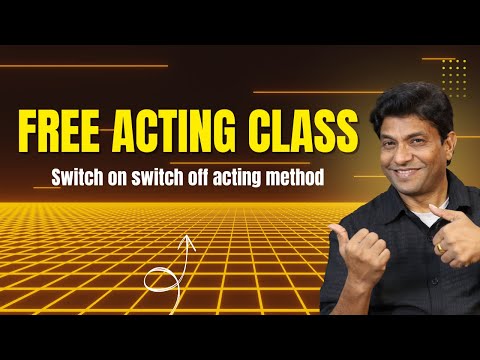
Watch: Free Acting Class — The SOSO Method
Virendra Rathore teaches the Switch On Switch Off (SOSO) acting method — the foundation of natural, camera-ready performance — in this free class:
Technique 3: Genuine Listening
In most beginner performances, you can see the actor waiting — waiting for the other person to finish, waiting for their cue word, waiting to deliver their line. The camera sees this. Real listening means your character is genuinely receiving what is being said and being affected by it, in real time.
Practical way to develop this: rehearse scenes where you do not know exactly when your partner will deliver their next line. Or ask your scene partner to change a word or phrase in rehearsal without warning you. This forces your brain to stay genuinely present rather than pre-loading the next response.
Technique 4: Correct Eyeline Placement
For self-tapes and most on-set shots, your eyeline — where you are looking when you speak or react — should sit just beside the lens, not into it. The difference on playback: looking into the lens can feel accusatory or strange unless the script specifically calls for direct address. Looking too far off to the side makes you appear to be avoiding contact. Just beside the lens — at the level of your imaginary scene partner — is the natural zone.
For self-tapes: tape a mark just beside your phone camera at eye level. Practise talking to that mark rather than anywhere else.
Technique 5: Hitting Your Mark
A mark is the exact spot on the floor where you stand so the camera and lighting are correctly set for your shot. Missing your mark means you might be out of focus, out of frame, or in shadow. On a professional set, consistently hitting marks without looking down at them separates actors who get called back from actors who do not.
Practise at home: put a piece of tape on your floor. Walk into the scene naturally and land precisely on it, every take. Do it until it is automatic enough that your attention stays on your scene partner, not on your feet.
Watch: Camera Acting Nuances — On Location with JoinFilms
A practical on-location breakdown of the specific nuances of camera acting — what changes from the rehearsal room to the actual set:
Technique 6: Continuity
A scene is shot multiple times from multiple angles. Editors cut between these angles to build the final sequence. If you pick up a cup with your right hand in take one and your left hand in take three, the editor cannot cut those shots together without a visible jump. Continuity is not a creative skill — it is a professional skill, and casting directors know within a few takes whether an actor has it or not.
Simple continuity habits to build: note which hand you use for physical actions on the first take and repeat it exactly. Track the pace of your movement — walking speed, gesture timing. On self-tape auditions, record your slate and action entry the same way on every take.
Technique 7: The Switch On / Switch Off Method (SOSO)
Developed through JoinFilms Academy, the SOSO method — Switch On, Switch Off — addresses the mental health and performance challenge of inhabiting emotionally intense characters. The core principle: enter the character's emotional world fully before 'action,' and leave it completely after 'cut.' This serves two purposes:
Performance: Actors who stay 'switched on' between takes often burn out emotionally across a long shoot day and deliver less by the afternoon. Actors who can switch in and out maintain peak availability per take.
Mental health: Carrying a character's grief or anger off set, outside of working hours, serves neither the performance nor the actor's wellbeing. A clear mental boundary — 'that was the scene, this is real life' — is a professional skill, not a weakness.
The Most Common Camera Acting Mistakes (And How to Fix Them)
Over-projecting the voice — the mic is close. Speak at conversation level; let the sound department do their job.
Moving before the emotion — if you physically react before you have internally registered what just happened, the performance looks mechanical. Feel it, then move.
Blinking too much under pressure — nervous blinking reads as anxiety rather than character. Practise holding a steady gaze in your close-up moments.
Looking at the floor to find marks — it breaks the scene. Practise until marks are automatic.
Ending the performance early — stay in the scene until the director calls 'cut,' not when you feel your last line is done.
Building Camera Presence Through Training
Camera presence is not a quality you either have or do not have — it is built through deliberate practice in front of a camera with honest feedback. The fastest way to develop it is to record yourself regularly, watch the recordings critically, and work with a mentor who can identify specifically what is reading as forced versus genuine. JoinFilms Academy's courses are built specifically around this — live camera work, scene study with feedback, and the SOSO method applied to real material:
Natural acting for camera means performing at the right scale for the lens — contained, specific, and emotionally genuine rather than projected and demonstrated. It involves techniques like reduced physical expression, real eye work, genuine listening, and correct eyeline placement.
How is camera acting different from stage acting?
Camera acting requires significantly less external expression than stage acting. On stage, you project to the back row. On camera, the lens comes to you — a close-up fills the screen with only your face and eyes, meaning small, real expressions carry far more impact than large, projected ones.
How do I become more natural in front of the camera?
Record yourself performing a scene, watch it back critically, then repeat at lower external energy while keeping the same internal truth. Work with a scene partner and focus on genuinely listening and reacting rather than delivering lines. Regular camera practice with honest feedback is the most reliable path.
What is the SOSO acting method?
SOSO stands for Switch On, Switch Off — an acting method developed at JoinFilms Academy by Virendra Rathore. It trains actors to fully enter a character's emotional world before 'action' and completely leave it after 'cut,' enabling stronger per-take performance and protecting mental health during demanding roles.
What is eyeline in acting and why does it matter?
Eyeline is where you look when you speak or react on camera. For most shots, the correct eyeline is just beside the lens — at the level of your imaginary scene partner — not into the lens and not far off to the side. Wrong eyeline makes performances look unnatural on playback and is one of the most common beginner mistakes.
About the Author — Virendra Rathore
Virendra Rathore is the Founder and Chief Mentor of JoinFilms Academy. A Dadasaheb Phalke Film Foundation Award winner (Best Acting Mentor), TEDx speaker, and bestselling author of the "Switch On Switch Off Acting Method," he brings over 25 years of experience across acting, direction, and film production. Creator of JoinFilms — one of India's largest independent filmmaking communities, with over 2.9 million subscribers on YouTube.
IMDb profile. Career Guidance:Get Free Bollywood Career Guidance →

 Launch your Graphy